|
Carl
Jung: Wounded Healer of the Soul, by Claire
Dunne. (New York: Parabola, 2000.)
Book reviews by Rob Couteau |
|
|
|
|
|
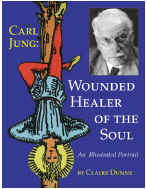
The nineteenth century hosted significant progress in rationalism and scientific research, yet by mid- to late century there was a resurgence of things of a more occult or spiritual nature, such as Eastern religion, parapsychology, and Madame Blavatsky’s theosophy. In seminars from the 1920s and ’30s, Carl Jung (discoverer of the archetypes, the collective unconscious, and the synchronicity principle) observed that in order for such nonrational phenomena to be taken more seriously, it was necessary to establish a scientific manner of dealing with them. This could lead to institutional structures that would legitimize the study of the psyche or soul. One of the leading psychologists of the time, Jung was ideally suited for such a task, in part because he believed that, besides a sexual instinct, there was a religious instinct: that psychic energy was, in essence, spiritual, and that we are driven by it to become whole and to strive for meaning. He called this mythopoetic quest the individuation process: one rooted in universal patterns yet unique in its expression. Although he preferred to be remembered as a scientist rather than a Madame Blavatsky-type of figure, Jung’s work was promulgated by the New Age movement of the 1950s, ’60s, and ’70s. While academia resisted Jungian-oriented research, his ideas continued to transform fields as diverse as humanistic psychology, anthropology, comparative religion, literature, painting, and art criticism. By the late ’80s and early ’90s, his ideas gained a wider audience as a result of the Bill Moyers interviews with Joseph Campbell (later published as The Power of Myth; 1988) and publications such as Robert Bly’s Iron John (1990) and Clarissa Estés’s Women Who Run with the Wolves (1992). In each of these examples, the spiritual dimension of his work comes to the fore while the scientific dimension recedes to the background. Given this peculiar turn of events, a study of Jung that focuses on his spiritual aspect is especially suitable. This is also the case since too many previous biographies have served either as an “official” Jungian homage that neglects to explore his darker side or as a critical attack from authors who, at the outset, equate “spiritual” with “nonsense.” Bearing this in mind, Claire Dunne’s Carl Jung: Wounded Healer of the Soul approaches his life in an innovative manner. She chronicles each developmental stage with a minimal amount of narrative, weaving it into longer passages from Jung’s own writing: primarily, his letters and autobiography. These comprise his most intimate expressions. Although it’s more of a primer of Jungian thought than a biography (the narrative is so minimal that it simply links selections taken from Jung’s publications), Wounded Healer contains a valuable collection of spiritual reflections. In addition, it’s a physically beautiful book, with reproductions of cultural artifacts; works of fine art; photos of Jung’s family, friends, and colleagues; and examples of his watercolors and sculptures. Dunne includes a succinct treatment of two enduring taboo subjects: the accusation that Jung was anti-Semitic and a pro-Nazi sympathizer (in the 1930s, during the rise of National Socialism, he published an essay on the so-called difference between Jewish and Aryan psychology; more on this later); and an homage to his former patient, colleague, and lover, Toni Wolfe:
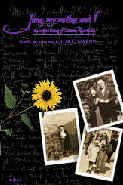
Jung’s brilliance was exemplified by his discovery of universal psychic factors that are contained within everyone (i.e., archetypes). But the need to understand what is “generally true” about cognition and behavior led him to make generalizations of a cruder, less insightful nature. He believed that, between the personal and the collective unconscious, other dimensions of psyche were determined by a cultural and racial past: that national qualities were not only imprinted on us by the environment but that they were also, in part, inherent. While the notion of a universal unconscious remains his most enduring contribution, behind this spiritually uplifting idea we find lurking a shadowy dimension that includes crass expressions of racial bigotry and bias. A recently published document sheds additional light on such matters. Jane Reid’s narrative of her mother’s extended analysis with him, Jung, My Mother, and I, contains the most comprehensive–and most damaging–record of these shortcomings. For example, when speaking to her mother, Katy Cabot, about a neurotic Jewish patient, Jung remarks:
Therefore, just a few years after defending his published views on “Jewish psychology,” Jung was continuing to voice such racist ideas privately, to patients and therapists-in-training. The same year he made this statement (1941), however, he was also referring to Hitler as “sinister” and “infected by the Unconscious.” According to Jung, the “Germans were in league with the devil, and had a lust for power which is satanic.” While Jung was certainly no Nazi (this document offers conclusive proof of that, as do other remarks made in private seminars held in the 1930s; e.g., see his recently reissued lectures on Nietzsche’s Zarathustra), he expressed many of the same prejudices that the Nazis–and many Europeans of this period–were prone to. Besides being a product of those racist times, he attempted to integrate racial and national prejudices into his psychological theories, thereby hoping to institutionalize and promote them, implicitly and explicitly, in his publications, seminars, and training programs. Though many of his actions were clearly pro-Semite (e.g., he personally assisted in the resettlement of Jewish refuges who were escaping from the Holocaust),* too many of his ideas on ethnicity and race were clouded by such biases. “In America,” he says, “there is a bit of everything: Negroes, Italians, etc. and a large contingent of Irish, not a distinguished tribe, but a wild tribe of Irishmen, with manners that are by no means English.” Elsewhere, he calls the Irish “utterly irresponsible!” He believes one must have a psychological defense against becoming too impressed by other nationalities–a kind of justifiable prejudice–otherwise one “goes under” and loses one’s national identity and character. (He also used this expression in a racist context in many of his private seminars when referring to his trip to Africa.) On Swiss Catholics versus Protestants, he remarks: “the Protestant [community] … has nicer people, is more orderly, whereas the Catholic one is more primitive and less orderly. In a Protestant country, people have better relations with one another. The ‘Church’ in Catholic countries takes the place of the ‘relation to people.’” About 200 pages after this passage, which is a verbatim account taken in shorthand by Katy during her analysis with Jung, narrator Jane Reid (Katy’s daughter, who was given the analytical records by her mother shortly before she died) adds, in a narrative commentary: “Katy returned frequently to the subject of Catholicism with Jung…. It was only from Jung that she could obtain an unbiased opinion.” (My emphasis.) Evidently, daughter Jane, who is a Jungian analyst, is also untroubled by such bizarre notions. (This is an unsympathetic narrative on the daughter’s side, however, who was more identified with her grandparent’s puritanical severity and who resented her mother’s unconventional, “flapper” lifestyle.) Katy Cabot began her analysis with Jung in 1929, and it continued until 1958. The daughter of a Naval lieutenant who was assigned to international ports, she was often left in the care of boarding schools and convents in Europe. After spending many of her formative years there, when she returned at age nineteen to Boston to live with her parents (1913), she experienced a severe culture shock. This seems to be the event that set the stage for the psychic conflicts that follow. While the adult Katy feels that she had more freedom than the average child, it’s obvious that her family exerted excessive control over her early life. They envisioned only one possible role for her: marriage to a “suitable” husband. She does find a man who is suitable as far as social standing is concerned, but in terms of being a soul mate he falls short. After they marry, she feels isolated and bored, living in the backwater of a cultural void named Charleston, West Virginia. When her daughter Jane contracts TB, Katy takes her to Italy to recuperate. Once Jane is better, Katy refuses to budge from Europe. After her husband’s premature death, she no longer needs to pretend that she’ll eventually return to America. As a result of her parent’s obsessive focus on socializing so that she can find a suitable mate, Katy develops a taste for what Jung calls “superficiality” and “nonsense.” Although overly identified with her extroverted, “social creature,” the need to develop inner values presses upon her, and the unconscious reacts by “forcing her under,” with a depression. (Jung was ahead of his time in realizing that depression served a positive function, forcing one to reexamine life in order to live in greater accord with the authentic self.) This leads her to Zurich and to Jung: possibly, the only spiritual center available to her at that time. In a classic example of the transference (in which we project unrealized aspects of the self upon the analyst), her analysis is centered on her perception of him as a religious figure. He becomes a touchstone to deeper psychic levels that she feels she cannot attain on her own. Jung suffered a heart attack in 1944 and had what is now referred to as an out-of-the-body experience. Hoping to ameliorate her affliction, he shares what was revealed:
Afterward, in a fitting counterpoint to the bad blood that exists between Katy and her daughter, Jung describes his unique concept of “kinship libido.” He defines this as a need to “establish the original family relation on a spiritual level”: As the institution of marriage expanded from couplings within a tribe to those with neighboring tribes and, finally, to those with complete strangers, the need to reestablish an intimate “spiritual clan” is intensified. “We [moderns] have a neurosis because the endogamous libido is not satisfied.” Therefore,
Jung encouraged his patients to sever unhealthy family ties and to befriend those who establish an authentic relationship with the Self. He envisioned a community that was unrestricted by social expectations and governed by values that were truly Self-reflective. An invaluable account of his work (and, so far, the lengthiest record of an analysis with Jung), the diary chronicles this attempt to create a psychological “family.” The self-appointed patriarch of the clan is portrayed as a genius who often stumbled because of shortsightedness; a bright intellectual and scholar who also thrived as a gardener, gourmet, and sensualist; and the promoter of a transpersonal consciousness who was ever the egoistic celebrity. The diary also captures the gemütliche Jung: at ease before a crackling fire, kindling a pipe of tobacco, and warming to an intimate exchange of thought and feeling. _________________________ * This review was originally featured on the author’s Web site in 2006. * “Jung’s unpublished correspondence from 1934 onward contains many copies of official Atteste, notarized statements submitted to the Fremdenpolizei, the Swiss government agency responsible for admitting foreigners to the country. In many, Jung guaranteed that if for any reason these persons were unable to support themselves, he would assume all financial responsibility. These Atteste were signed on behalf of persons who range from those totally unknown today to those well known in the Jungian community, among them the French theorist Roland Cahan, and Jung’s old friend Jolande Jacobi. Jung treated many Jewish patients without charge once they managed to get into Switzerland, among them Aniela Jaffé, who later became his secretary and collaborator on his autobiography. Letters abound similar to the one he wrote to Heinrich Zimmer on the eve of his immigration to the United States, telling him of persons he had contacted on Zimmer’s behalf. And he wrote many more to persons in England and the United States, often ordering them to ‘help this Jew’ (his emphasis).” Deirdre Bair, Jung. A Biography (NY: Little, Brown and Company, 2003), pp. 459-460. According to Bair, when Allen Dulles entered Switzerland in November 1942 he was secretly working as an “advance man” for the U.S. Office of Strategic Services (OSS) in Switzerland. (Dulles would later head the CIA.) “For some time, Jung became Dulles’s ‘sort of senior advisor on a weekly, if not almost daily, basis.’” The following year, “Jung became ‘Agent 488’ in Dulles’s reports to OSS offices in Washington and London, and 488’s dispatches were considered fact and figured prominently in the agency’s operational policies.” Dulles said Jung “[understood] the characteristics of the sinister leaders of Nazi Germany and Fascist Italy. His judgment on these leaders and on their likely reactions to passing events was of real help to me in gauging the political situation. His deep antipathy to what Nazism and Fascism stood for was clearly evidenced in these conversations.” In fact, Jung constructed the first in-depth psychological profiles of political enemies such as Hitler. “By 1945 […] Jung’s views on how best to get [German] civilians to accept defeat were being read by the Supreme Allied Commander, General Dwight D. Eisenhower. Jung’s analysis of Nazi propaganda was that it tried ‘to hollow out a moral hole with the hope of eventual collapse.’” Ibid., pp. 492-494. |
|
|
This review
is featured in: |
|
|
Related links: Rob Couteau reviews John Weir Perry's The Far Side of Madness. Like Jung and R.D. Laing, Perry also viewed psychosis as potentially purposive and telic in nature. This review summarizes his approach.
Updated: 29 June 2011 | All text Copyright © 2011 | Rob Couteau | key words: Jung, My mother, and I Wounded Healer Nazi psychosis Carl Jung and anti-Semitism |