Biography
of
Rob Couteau
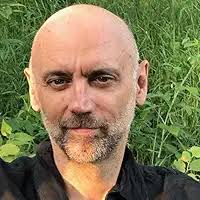
Author and publisher Rob Couteau is known for his interviews with
prominent writers and for his portrayals of expatriate life. Born in
1956, Couteau grew up in Gravesend, Brooklyn, during the 1960s and
‘70s, an environment that profoundly shaped his coming-of-age
experience. His memoir, Intimate
Souvenirs (2023), vividly recounts this period, chronicling the
writer’s development amid hardscrabble streets, a repressive Catholic
elementary school, and the rich cultural undercurrents of New York
City.
In 1974 he graduated from Brooklyn’s John Dewey, then considered the most
progressive experimental high school in America. He attended both
Hunter College and the State University of New York, where he earned a
Bachelor of Science in Art Education in 1978. He later worked as a
teacher in some of Gravesend’s more challenging public schools; as a
construction worker in Manhattan; and as a counselor and advocate for
the homeless mentally ill, many of whom suffered from schizophrenia.
These diverse experiences are rendered with grit and flair both in his memoir and in his first novel, Doctor
Pluss (2006).
Career
Three years after its publication, Doctor Pluss came to
the attention of Barney Rosset, former owner of Grove Press and
publisher of writers such as Samuel Beckett, Pablo Neruda, and Jack
Kerouac. Rosset also spearheaded the legal battle to publish D. H.
Lawrence’s unexpurgated Lady
Chatterley’s Lover and Henry Miller’s Tropic
of
Cancer, defending the latter in over sixty obscenity trials, all
the way to the U.S. Supreme Court in 1964. In 2009, after Couteau
attended Rosset’s last public lecture, Rosset arranged for editor Jim
Feast to review Doctor Pluss
and Collected Couteau (an
anthology of poems, essays, and interviews) in Rosset’s Evergreen
Review. Feast lauded both texts, noting their “intellectual
freshness, richness and potency,” concluding: “Couteau is an
impressively creative writer, whom Barney Rosset urged me to review.”

[First
edition, with cover photo by Couteau]
In 2020, the Midwest Book
Review published a review of the third, revised edition of Doctor
Pluss by senior editor Diane Donovan:
One
does
not wish for more in Doctor
Pluss. It’s complete unto itself, exceptionally well developed,
and emotionally compelling, connecting metaphorical description with
experiences that often challenge the traditional roles of doctor and
patient, linking them in unexpected ways.... His
interpretations and descriptions of the schizophrenic experience are
particularly astute, astonishing, and evocatively described. When
Pluss vanishes, a ripple of effects on doctors and patients alike
threatens to change everything. A regression process takes place that
questions both convention and traditional roles. Readers
who choose Doctor Pluss are
in for a treat. It’s like One
Flew Over the Cuckoo’s Nest on steroids: a thought-provoking
examination of sanity, insanity, and the crossover process that leaves
readers thinking long after this therapeutic slice of life is
consumed.
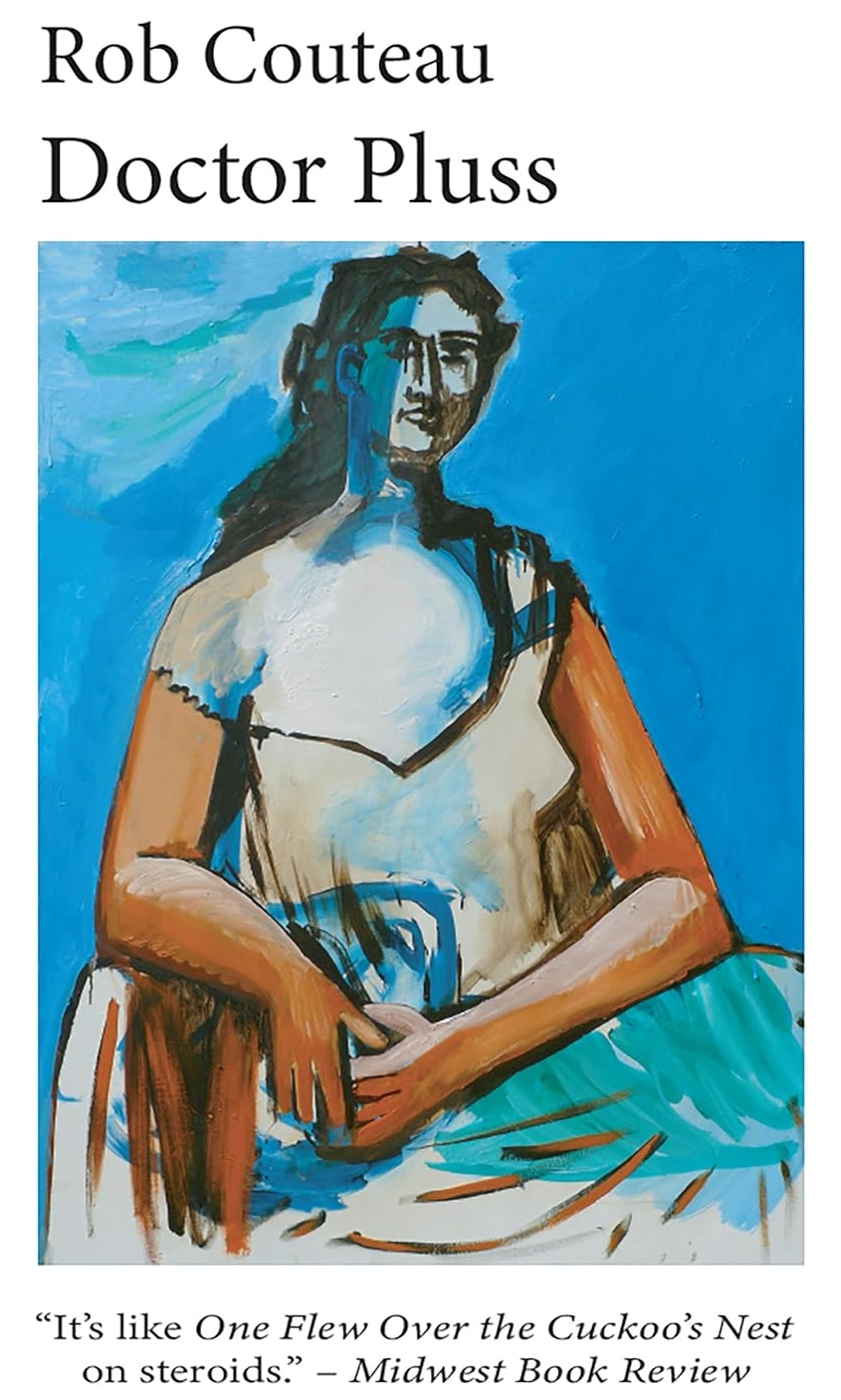
[Third
edition, with one of the author’s large oil paintings reproduced on
the cover]
Creative Evolution
Couteau’s initial literary forays drew from a tapestry of modernist
influences, especially movements rooted in a rebellion against
conventional constraints. By his late twenties he was already
experimenting with diverse forms, such as poetry, fiction, and memoir,
as well as book reviews that dissected the work of literary giants
such as Walt Whitman and Henry Miller. This period laid the foundation
for an interdisciplinary style in which art and literature intertwine,
a synthesis reflected in his work as both a visual artist and a
literary craftsman. His oeuvre reflects an enduring curiosity about
human resilience amid social upheaval and an affinity for unfiltered,
experiential storytelling.
Shortly before his twenty-ninth birthday, Couteau’s essay “Must World-mindedness Destroy National Identity?” (1985) was selected as the winner of the North American Essay Award, an annual competition sponsored by the American Humanist Association, open to North American writers. The winning piece underscored his talent for incisive, reflective nonfiction, and the cash prize helped to finance his first trip to Europe. This accolade validated his humanistic approach and positioned him within a tradition of essayists who prioritize innovation and philosophical depth.
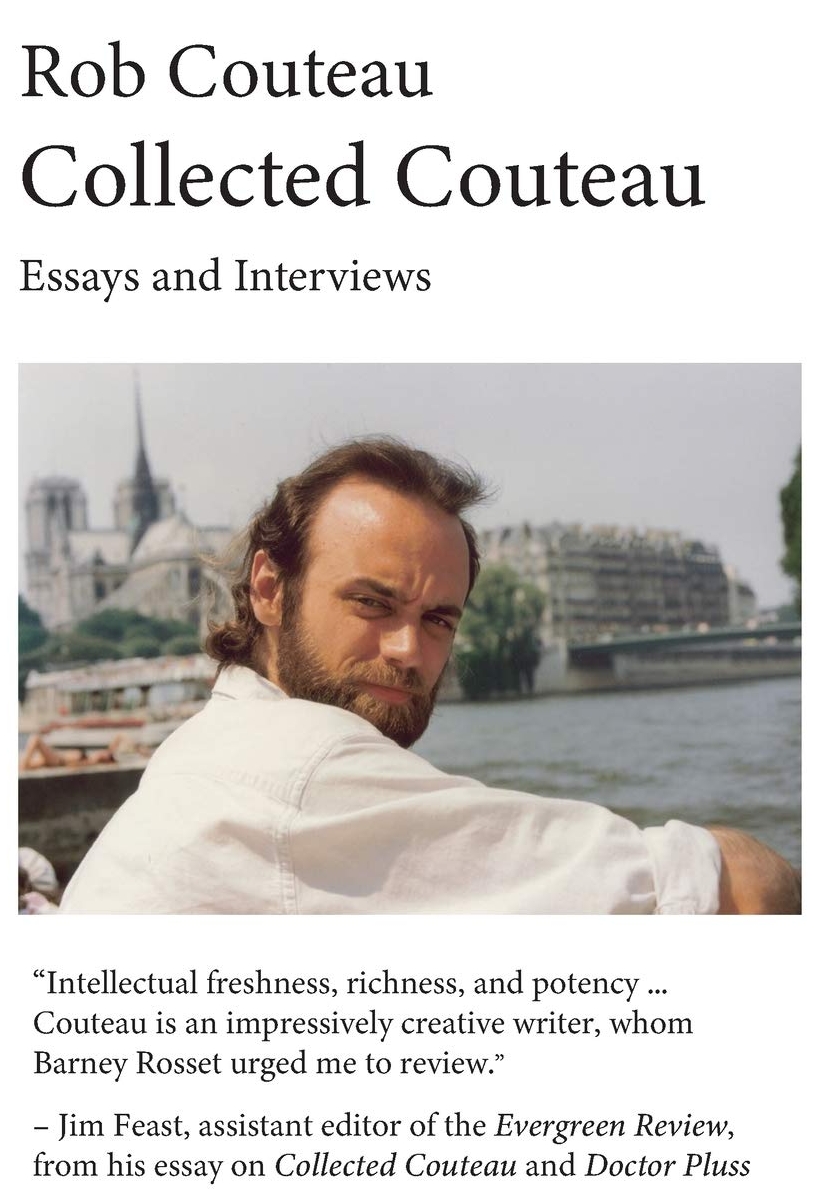
[Collected Couteau,
featuring a photo of the author seated beside the Seine]
Interviewer and
Cultural Chronicler
In the early '90s, Couteau began to interview other authors. These
probing conversations appeared in outlets such as Rain Taxi Review, The Paris Voice, Dichtung
Yammer, Kennedys and King,
Emerging Civil War, and The
Bloomsbury Review and were later cited in periodicals such as
the New York Times, Senses of Cinema, and Architectural
Digest. Many of these dialogues captured the essence of
individuals who defined eras of rebellion and change. Among his most
notable subjects are LSD discoverer Albert Hofmann, whose insights
offered a window into altered states of consciousness; Last
Exit to Brooklyn novelist Hubert Selby, whose raw depiction of
urban decay aligned with Couteau’s interest in marginalized
narratives; and sci-fi celebrity Ray Bradbury, whose tales had
captivated Couteau’s imagination as an adolescent.
Both as an interviewer and an essayist, Couteau is known for his
meticulous preparation and passionate engagement. As the author James
Dempsey notes in his introduction to More
Collected Couteau:
You’ll also find herein Couteau’s writings on literature, which I
hesitate to call criticism since they lack the worst features of much
literary criticism, which can be clogged with so much pretentiousness,
cant, and philosophical obfuscation that it would take a plunger of
Brobdingnagian proportions to restore a healthy flow. Couteau’s essays
are often rhapsodic appreciations and evocations of the work under
study, and are stuffed with both insights and joy.
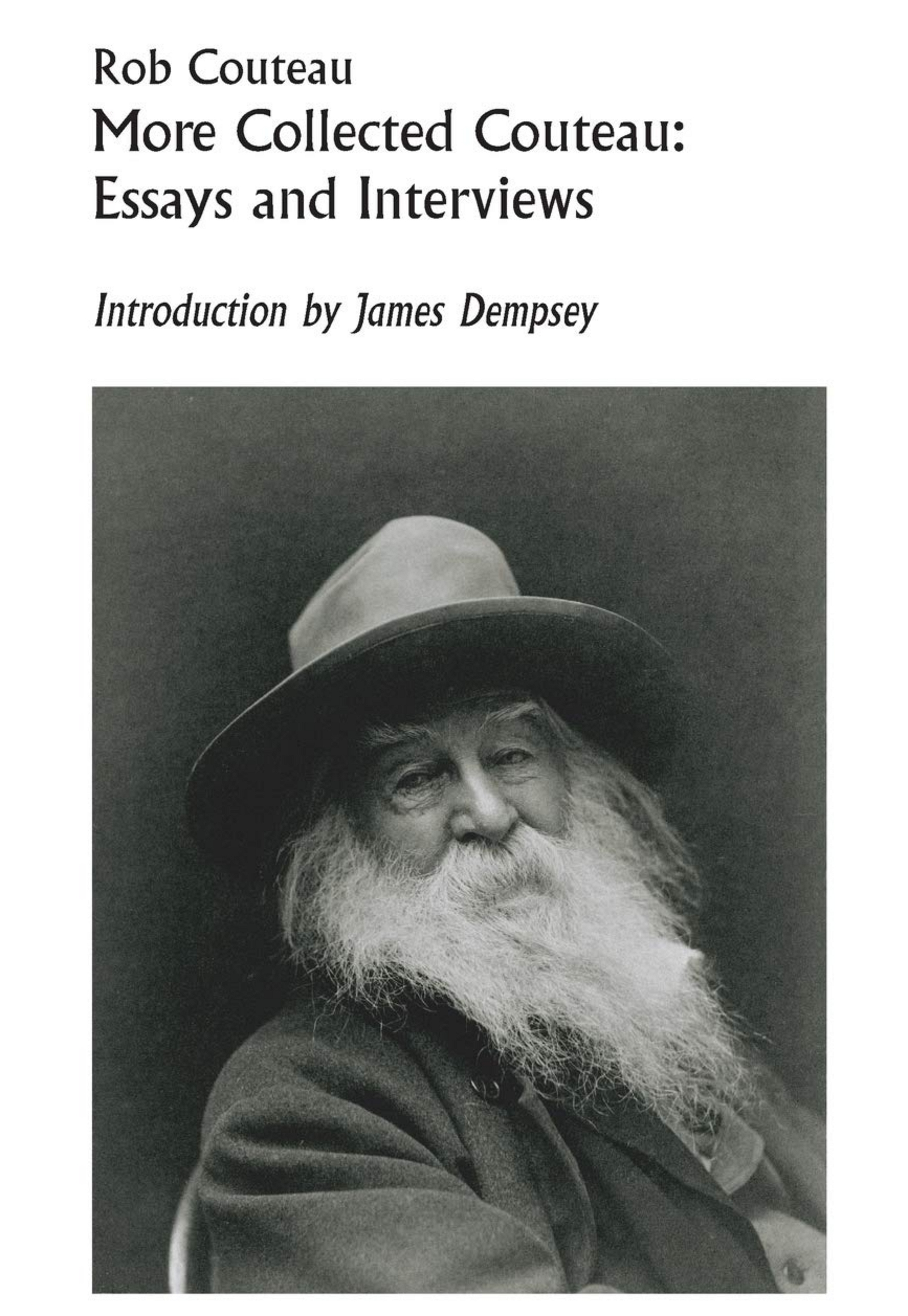
[More Collected Couteau,
with a cover photo of Walt Whitman]
Couteau’s interviews extend far beyond mere transcription. They
form a mosaic of intellectual history, assembled through conversations
with personalities such as Picasso’s model and muse, Sylvette David,
whose artistic legacy provides a lens on modernism; novelist and
Nabokov biographer Robert Roper, whose writing bridges fiction and
biography; and historian Philip Willan, author of Puppetmasters:
The Political Use of Terrorism in Italy, whose reportage delves
into geopolitical intrigues. Other participants include the former
editor-in-chief of Simon & Schuster, Michael Korda; Pulitzer
Prize-winning author Justin Kaplan; and Paul Bowles biographer
Christopher Sawyer-Lauçanno, who crafted an introduction to Couteau’s
first poetry collection, The
Sleeping Mermaid (2010). Most of these interviews were
republished in the anthologies Collected
Couteau (2006) and More
Collected Couteau: Essays and Interviews (2016).
Utilizing an empathic yet probing approach, Couteau elicits
revelations that humanize such icons, revealing their achievements as
well as the arduous struggles behind their accomplishments. By
assembling these interviews and essays into print anthologies, he not
only archives literary history but also invites readers to actively
engage with it. Positive reviews in New
Art Examiner, Publishers
Weekly, Witty Partition, Cable Street,
Evergreen Review, and Midwest
Book Review affirmed the caliber of his work and commended its
wide-ranging erudition.
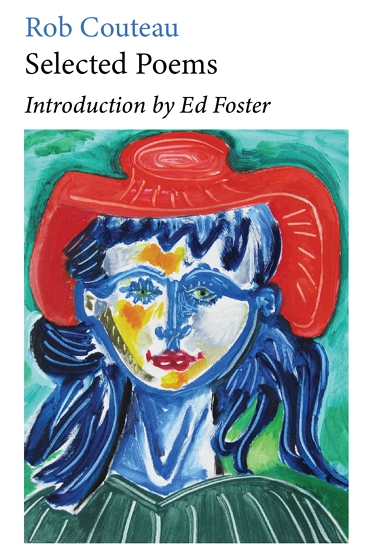
[Selected Poems, with cover
art by Couteau]
Legacy
Spanning more than two decades, Couteau’s bibliography includes both fiction and nonfiction,
excerpts of which have appeared in over fifty periodicals. To maintain artistic autonomy, many of these books are self-published. This independence aligns
with his roots in the indie publishing scene, as evidenced by
associations with publishers such as Ed Foster, whose Talisman House
imprint is acclaimed for its international prose translations and
avant-garde poetry. In 2020, Foster provided an introduction for
Couteau’s Selected Poems: a
collection with nearly one hundred pieces, forty of them published in
journals between 1985 and 2020. Foster hailed the verse for its stylistic lyricism, unique form, and vibrant painterly style:
Couteau’s
poetry
is marked by a clarity, a crisp directness of vision, and a
willingness to violate expected rhythmic and tonal expectations when
the poem calls for it.... There is a deep tenderness in these words,
mingled with the sadness of age ... There is much to admire in
Couteau’s oeuvre, but this tenderness stands out among so many things
that make reading his work clearly an important experience.
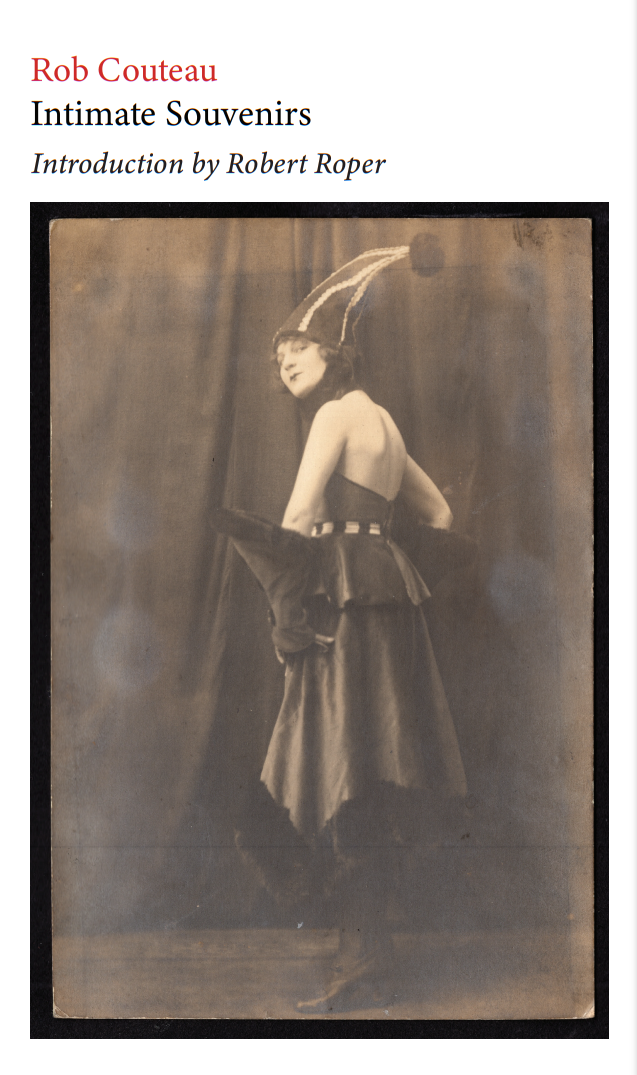
[Intimate Souvenirs, with a
photo of the author’s grandmother as a young woman working on the
vaudeville stage, circa
1916.]
Empathic connection also serves as a central theme in Intimate
Souvenirs (2023), a picaresque memoir of over 500 pages that portrays his childhood in Brooklyn, youthful
adventures in Manhattan, and expatriate years in Paris. Novelist
Robert Roper called it a “new, possibly classic memoir of New York”
that charts an unconventional path to a writer’s life outside academic
norms. Roper concludes:
That there still exists a
path to a writer’s life that is not a dutiful march through creative
writing academies, with perhaps the apotheosis of becoming a teacher
of yet more academy-shaped writers, is heartening to learn. Couteau
does not make fun of that approach nor of any other, but he does model
something much different, and to see him continuing to write books
like this one, which well deserves a place on his already considerable
shelf of valued books, is excellent news.
Expatriate Life
and Later Years
Couteau settled in Paris as an
expatriate from 1988 to 2000, a period prominently featured in his
memoir. In 2000 he returned to New York, where he continued writing
and exhibiting artwork at the Roshkowska Gallery in Hudson. Since 2020 he has devoted himself to annotating and
publishing texts of important but largely forgotten authors such as
Stanley Marks (Murder Most
Foul!), Charles Beadle (Dark
Refuge), Francis Carco (From
Montmartre to the Latin Quarter), and Edith Halford Nelson (Desert
Sanctuary).
Couteau’s interest in neglected cultural figures is especially
evident in A Blind Man Crazy
for Color: A Tribute to Léon Angély (2022), later revised as Picasso, Modigliani, and a Blind
Man Crazy for Color (2024). This book examines the life of Léon
Angély, a nearly blind Montmartre collector who acquired works by
Picasso, Modigliani, and Utrillo before these artists achieved
international renown. Drawing on archival research and literary
reconstruction, Couteau explores the legend that Angély selected art
with the assistance of a young girl who served as his “eyes,” a
relationship believed to have inspired Picasso’s celebrated “Blind
Minotaur” imagery. The volume is illustrated with original paintings
by Picasso’s model and muse, Sylvette David, whose watercolors and recollections contribute an additional
historical dimension to the project.
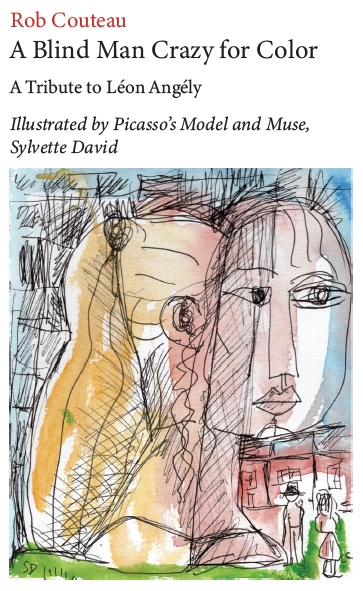
[Featuring cover art and illustrations
by Picasso's muse, Sylvette David]
Reviewers praised the book for its
historical excavation and poetic atmosphere. Writing in Midwest
Book Review, Diane Donovan described it as “required reading”
for art historians, commending its blend of biography, analysis, and
history. New Art Examiner critic Scott Sublett called it “strange” and
“fascinating,” emphasizing its reconstruction of the elusive Angély
legend and the added resonance provided by Sylvette’s paintings. And Witty Partition editor
Bronwyn Mills recognized its “rare grace,” noting Couteau’s ability to
weave quotations, anecdotes, and archival discoveries into “lustrous
prose.” The book was acquired by a number of research libraries around
the world, including the Museum of Modern Art Library, in New York.
UPDATED:
JULY 2026